

Knowledge Base September 3, 2026
How to Choose a Kettlebell: Weight, Types, and What to Check Before You Buy
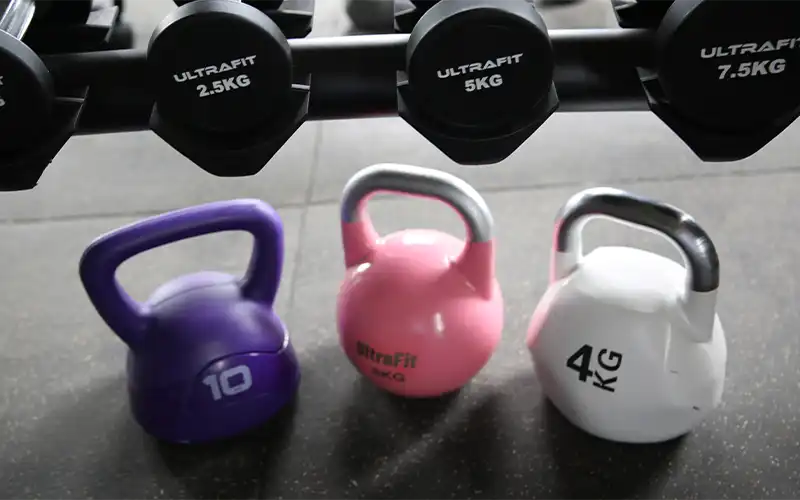
Quick Summary: Choosing a kettlebell comes down to three decisions — the weight, the type, and the build quality.
Find your starting weight with the two-minute swing test (most women start at 8 kg, most men at 16 kg). Pick cast iron for value, rubber-coated for quiet floors, or competition kettlebells for sport. Then run five quick checks before you buy.
Buying kettlebells for a gym or your own brand? Get a factory-direct quote →
Find your starting weight with the two-minute swing test (most women start at 8 kg, most men at 16 kg). Pick cast iron for value, rubber-coated for quiet floors, or competition kettlebells for sport. Then run five quick checks before you buy.
Buying kettlebells for a gym or your own brand? Get a factory-direct quote →
How to Choose a Kettlebell Weight: Do the Swing Test, Not the Curl Test
The most common mistake is choosing a weight you can lift, not a weight you can swing. A kettlebell is designed to move with momentum — swings, cleans, snatches, goblet squats. If it is too heavy, your form falls apart in the first five reps. If it is too light, you never get a real training effect. The swing test below takes two minutes and works at any fitness level.
Do the swing test:
1. Stand with your feet shoulder-width apart, the kettlebell on the floor in front of you.
2. Hinge at the hips, grab the handle with both hands, and swing it up to chest height with relaxed arms.
3. Complete 15 repetitions with good form. If the last 2-3 reps still feel controlled, this weight is right for you.
4. If your back or shoulders take over before rep 10, the bell is too heavy — go down one size. If 15 swings feel easy and you want more load, go up one size.
Common starting points (always confirm with the swing test):
Sizes usually run like this: in the metric market, most factories cast kettlebells at 4, 6, 8, 10, 12, 16, 20, 24, 28, 32, 40 and 48 kg. If you are just starting out, buy the weight that passes the swing test today — and go up a size when you outgrow it. Over-reaching now means months of training with broken form.
| Who you are | A common starting weight |
|---|---|
| Woman new to kettlebells | 8 kg (18 lb) |
| Man new to kettlebells | 12–16 kg (26–35 lb) |
| Woman with strength training experience | 12–16 kg |
| Man with strength training experience | 16–24 kg |
| Double kettlebell work (two bells) | Same weight you use for single-bell swings, or one size lighter |
Kettlebell Types: Cast Iron, Rubber-Coated, or Competition
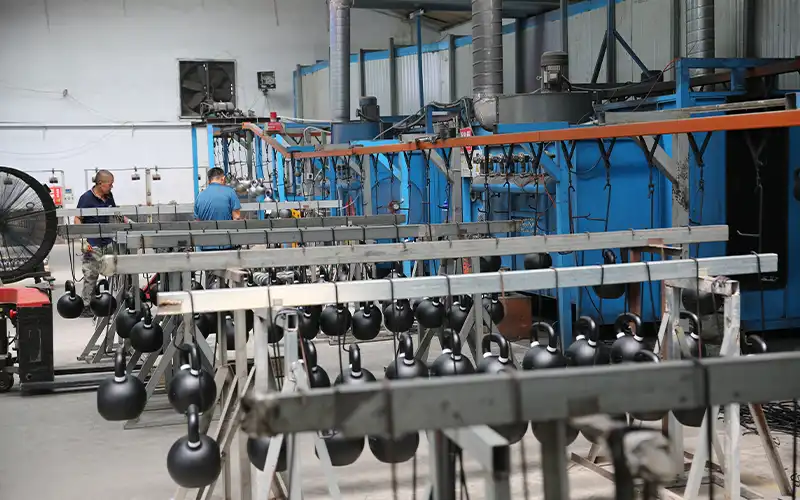
The three main types of kettlebell are cast iron, rubber- or vinyl-coated, and competition. They feel different in the hand, sound different on the floor, and suit different buyers — so pick by where the bell will be used and who will use it.
One thing to check with any type: is it a single-piece casting? A real kettlebell is cast as one continuous piece of iron — ball, handle, and base. Some low-cost factories weld the handle to the body instead. That weld is exactly where the force goes during a swing, and welded handles can snap. Ask how the bell is made before you buy. We explain the casting difference in detail in our article on how cast iron kettlebells are made.
| Type | What it is | Best for | Keep in mind |
|---|---|---|---|
| Cast iron (bare or painted) | One solid piece of cast iron | Best value, the classic standard for gyms | Loud on hard floors; paint can chip over the years |
| Rubber- or vinyl-coated | Cast iron core with a rubber or vinyl shell | Hotels, apartment gyms, studios — anywhere noise and floors matter | Adds cost, and the coating wears under heavy use |
| Competition | Steel body, every weight is the same size | Kettlebell sport, serious swing and snatch training | Highest price per kilogram |
The Handle Is the Product: What a Good Grip Feels Like
The handle is the only part of a kettlebell you actually touch — and a bad handle makes a good weight useless after twenty reps.
What makes a handle good:
• Smooth all over. Run your fingers around the handle and along its inside curve. Casting seams, sand pits, or burrs tear up your hands over a session. A quality bell has a ground, polished grip.
• A comfortable window. The opening must fit two hands for two-handed swings, without crowding if you have large hands or wear gloves.
• Generous radius at the joints. Where the handle meets the body, the curve should be smooth and rounded. Sharp angles concentrate pressure into a narrow band across your fingers.
• Consistent shape. The handle should feel the same on both sides. An off-center mold throws the balance off and the bell wobbles mid-swing.
The best test is to swing it. If you are buying in a shop, swing the actual bell before paying. If you are buying online or ordering in bulk from a factory, ask for a pre-production sample first — a single sample costs little, and it tells you more about handle feel and finish than any spec sheet. Legitimate manufacturers expect this request.
Finish and Durability: Paint, Powder Coating, or Rubber
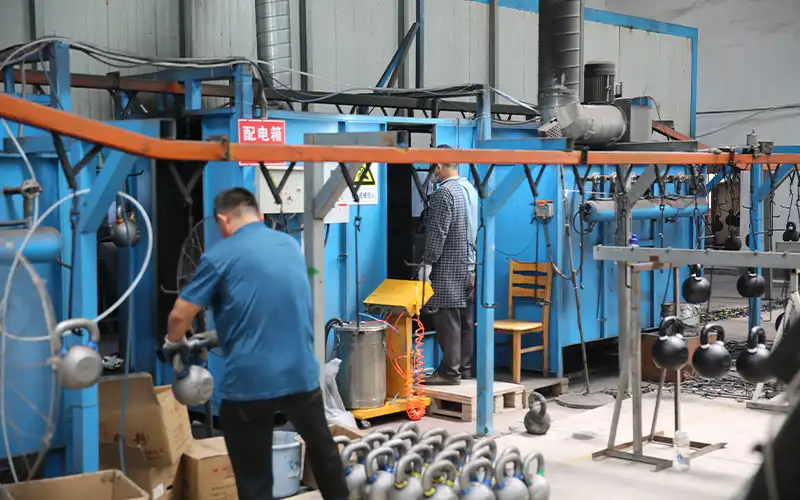
The finish decides how a kettlebell looks, how long it resists rust and chipping, and where you can use it without complaints from neighbors or building managers.
Finish options compared:
• Epoxy or liquid paint. The budget option. Smooth and colorful when new, but it chips over time — and once the bare iron shows, rust follows. Fine for light home use.
• Powder coating. Applied electrostatically and baked on, it forms a hard, chip-resistant layer. This is the default for commercial gyms, CrossFit boxes, and any high-use environment. Available in a wide color range, including color-coded weight sets.
• Rubber or vinyl coating. A rubber shell around the iron core. It protects floors and cuts noise dramatically — the standard for hotel and apartment gyms. It adds cost and weight, and the coating wears under heavy use.
• Bare cast iron. No coating at all. The most direct grip, common in painted competition settings, but it rusts easily if stored damp.
How to choose: ask where the kettlebell will live. Apartment or hotel gym → rubber-coated. High-traffic training floor → powder-coated cast iron. Kettlebell sport → competition bells. Home garage → powder-coated cast iron is the low-maintenance sweet spot.
Have questions about your specific requirements?
Talk to Our Team →Five Quick Checks Before You Buy (or Order in Bulk)
These five checks take two minutes and separate a tool you will keep for a decade from a decoration for the corner of the gym.
1. Flat base. Set the bell on the floor. It should stand level without rocking, and stay upright when you let go.
2. One-piece construction. Look at the joint between the handle and the ball. No welding seam should be visible. Ask the seller how the bell is cast.
3. Smooth handle. Slide your fingers along the whole handle, including the underside. Any seam or roughness is a deal-breaker.
4. True weight. Check that the weight marking is permanent — cast into the iron or engraved, not a sticker. If you can, compare it against a known weight on a scale.
5. Straight hang. Hold the bell by the handle and let it hang freely. A well-cast bell hangs straight; a twisted one tells you the mold was off-center.
Buying for other people? If you stock kettlebells for members or clients, add one more check: does the handle suit the widest range of hand sizes in your group? One bell can feel great in your hand and cramped in someone else's. When in doubt, a slightly larger handle window is the safer choice for shared equipment.
Buying Kettlebells in Bulk: What Trainers and Gym Owners Should Know
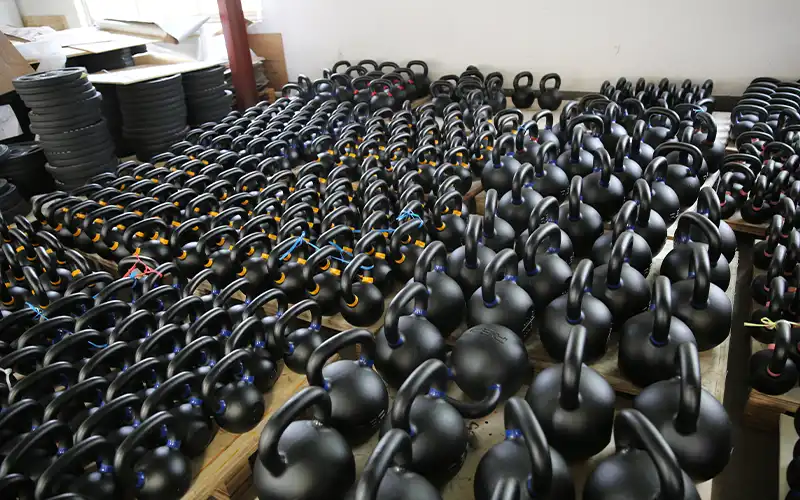
If you need 20 or more kettlebells for a studio, a gym, or your own brand, skip the retail middleman. The same kettlebell that carries a retail markup costs a fraction of that bought factory-direct — and you can put your own name and colors on it.
This is not a privilege reserved for big chains. Personal trainers setting up a studio, functional gyms replacing worn sets, and fitness brands launching their own line all buy directly from factories in China.
How to start (apply the same standard as the five checks above):
1. Write your specification. Weight range and quantities, finish (powder coat, rubber, paint), handle requirement, colors, logo, and packaging.
2. Order a pre-production sample. Swing it yourself. Verify the handle, the weight, and the coating against your spec before committing to a full run.
3. Confirm the commercial terms. MOQ, production lead time, payment terms, and shipping — FOB, EXW, or DDP. A serious supplier answers all of these in writing within days.
4. Ask for quality control documentation. For factory orders, this means the QC checks performed on your batch — weight tolerance, coating thickness, handle inspection.
At LanDer Fitness, we have cast and finished kettlebells for over 20 years at our ISO 9001-certified factory in Rizhao, China. One-piece cast iron from 4 kg to 48 kg, powder coat, rubber or paint finishes, and full OEM service — your logo, your colors, your packaging. We routinely send samples so buyers can feel the handle before they commit.
Want to see how a quality kettlebell is made before you order? Read our kettlebell factory guide, browse the kettlebell product range, or request a factory-direct quote.
Frequently Asked Questions
- 1. What weight kettlebell should a beginner buy?
- Do the two-minute swing test: if you can complete 15 controlled swings and the last few reps still feel smooth, that weight is right. As a starting point, most women begin at 8 kg and most men at 12–16 kg. It is better to start one size light and build up than to buy too heavy and train with broken form.
- 2. Cast iron vs competition kettlebell — which is better?
- For general strength and conditioning, a quality cast iron kettlebell is the best value and all most people need. Competition kettlebells keep the same outer size at every weight, with a uniform handle and tighter weight tolerance — worth the premium only for kettlebell sport athletes and serious swing and snatch programs.
- 3. Rubber-coated or bare cast iron kettlebell?
- It depends on the floor and the users. Rubber-coated kettlebells are quiet and protect floors — the standard for hotel and apartment gyms. Bare or painted cast iron is louder and can chip, but it offers the most direct grip and the best value for high-traffic training floors and garage gyms.
- 4. Can I order kettlebells with my own logo and colors?
- Yes. As an OEM manufacturer, we cast kettlebells from 4 kg to 48 kg and finish them in your colors with your logo — cast-in, engraved, or printed. A pre-production sample is recommended, and standard, before a bulk order. Contact us with your specification for a quote and lead time.