

Manufacturing June 25, 2026
Kettlebell Factory China — 20+ Yrs OEM/ODM | ISO 9001 Certified
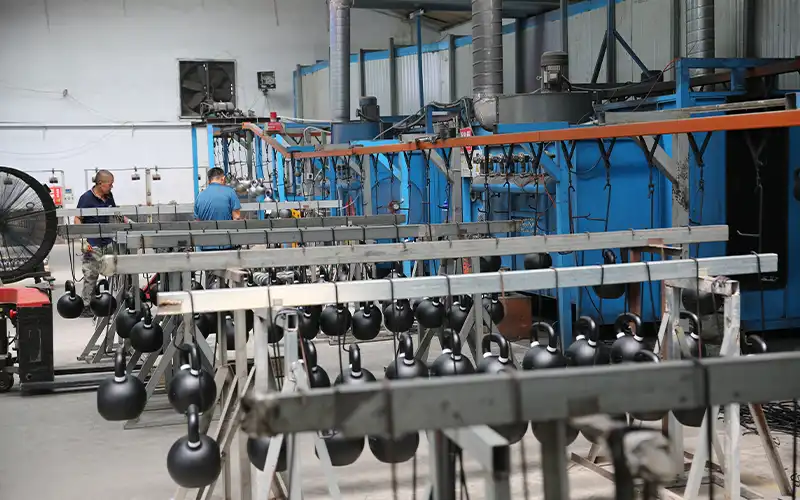
Quick Summary: We make cast iron kettlebells at our factory in Rizhao, China. One-piece casting, 3 surface finishes, 7 QC checks per batch.
Whether you need standard kettlebells at factory prices or fully custom-branded kettlebells, this is how we do it — and what you should know before ordering.
Contact us for a quote within 48 hours →
Whether you need standard kettlebells at factory prices or fully custom-branded kettlebells, this is how we do it — and what you should know before ordering.
Contact us for a quote within 48 hours →
Why Kettlebells Dominate Functional Training in 2026
Kettlebells have evolved from a niche strongman tool into the centerpiece of modern functional training — and global demand keeps climbing.
CrossFit boxes, boutique studios, home gyms, and corporate wellness centers all stock kettlebells. Why? Because no other single piece of equipment delivers the combination of strength, cardio, mobility, and coordination that a kettlebell swing, snatch, or Turkish get-up provides.
But here is what most buyers don't realize: a poorly made kettlebell is more than just uncomfortable. A rough handle tears up your hands after 20 reps. An off-center casting wobbles unpredictably. A thin paint finish chips after 3 months and exposes bare iron to rust.
We have been casting and finishing kettlebells for 20+ years at our factory in Rizhao, Shandong. Below is exactly how we make them — and what separates a professional kettlebell from one that ends up in the corner of a gym, unused.
Casting: One-Piece vs. Welded Construction — And Why It Matters
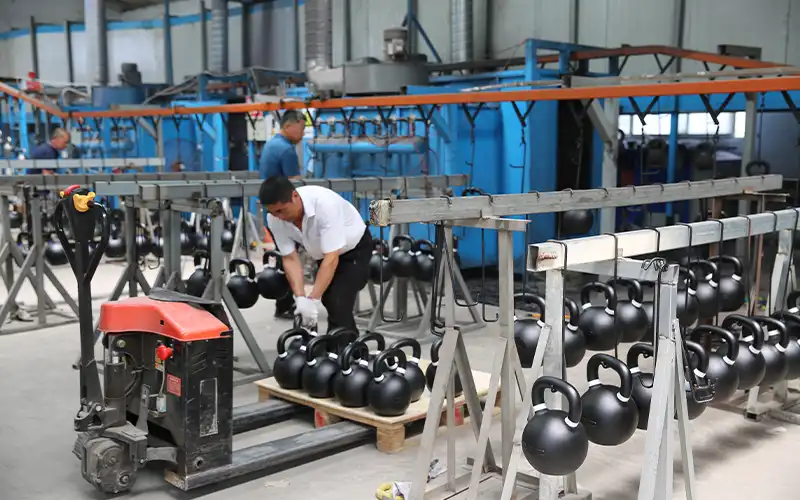
A real kettlebell is cast as a single piece of iron. Anything welded together from separate parts is a compromise — and a potential safety risk.
One-piece sand casting: Molten iron (typically gray iron, sometimes ductile iron for premium grades) is poured into a sand mold shaped exactly like the finished kettlebell. The entire body — the ball, the handle, the flat base — solidifies as one continuous piece. No joints. No weak points.
Welded construction (avoid this): Some low-cost factories weld the handle to the body separately. This creates a stress point exactly where the most force is applied during swings and snatches. We have seen welded handles snap under heavy use. It is rare, but once is enough to injure someone.
What we do: Every LanDer kettlebell is a one-piece iron casting — from 4kg to 48kg. Our molds are precision-machined for consistent wall thickness and base flatness. After casting, every kettlebell goes through shot blasting to remove sand residue and create a uniform surface texture ready for finishing.
Surface Finishing: Paint, Rubber, or Powder Coating — Which One?
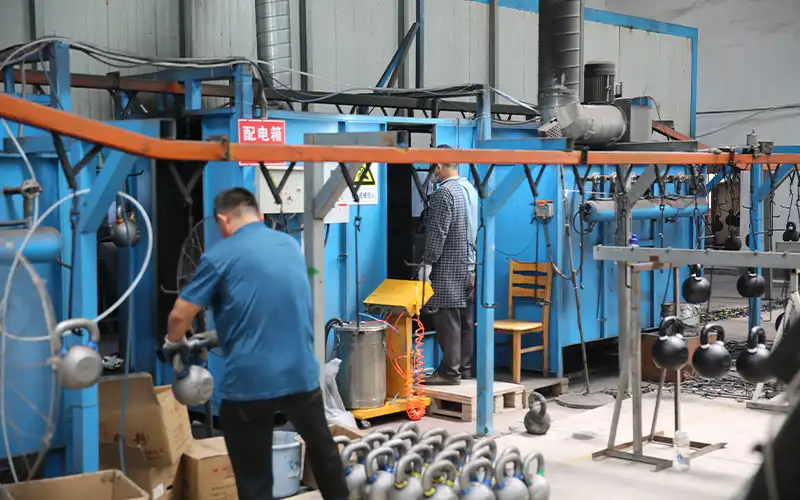
The finish on your kettlebell determines how it looks, how it feels, and how long it lasts. Three options, three different market positions.
Powder coating is our most popular choice for professional-grade kettlebells. Unlike liquid paint, powder coating is applied electrostatically and then cured in an oven at 180–200°C. The result is a hard, even layer that resists chipping, scratching, and rust — even after thousands of drops on concrete.
Rubber coating follows a similar process to our barbell plates: the cast iron kettlebell is placed in a mold, rubber compound is injected and cured under heat and pressure. The result is a fully encased kettlebell that protects both the equipment and the floor.
Not sure which finish fits your market? Tell us where you sell and your price point — we will recommend the best option. No cost, no commitment.
| Finish Type | Best For | Key Feature |
|---|---|---|
| Electrostatic Powder Coat | Commercial gyms, CrossFit boxes, competition use | Chip-resistant, textured grip, most durable |
| Rubber Coating | Hotel gyms, apartment gyms, noise-sensitive spaces | Floor-friendly, quiet on impact, protects surfaces |
| Epoxy Paint | Budget retail, entry-level home gyms | Lowest cost, smooth finish, wide color range |
Handle Finishing: The Part Your Customers Touch Every Day
A kettlebell lives or dies by its handle. Rough handles cause blisters. Thin handles dig into the palm. Poorly-radiused corners create painful pressure points.
How we finish every kettlebell handle:
1. Grinding and smoothing — Post-casting, the handle surface is ground down with progressively finer abrasives until it is completely smooth to the touch. No casting seams. No rough patches.
2. Radius check — The transition where the handle meets the body must have a smooth, generous radius. Sharp corners concentrate pressure into a narrow band across the fingers — painful and unusable.
3. Diameter consistency — Standard handle diameter: 33–35mm for most sizes, 35–40mm for competition kettlebells. Consistent diameter means consistent grip regardless of kettlebell weight.
4. Width check — The handle opening must comfortably accommodate hands of all sizes, with enough room for two-handed swings on larger bells.
This is slow, manual work. Every handle is inspected by hand before it moves to finishing. Machines cannot tell you if a handle "feels right" — only an experienced worker can.
Have questions about your specific requirements?
Talk to Our Team →Brand Customization: Your Kettlebell, Your Identity
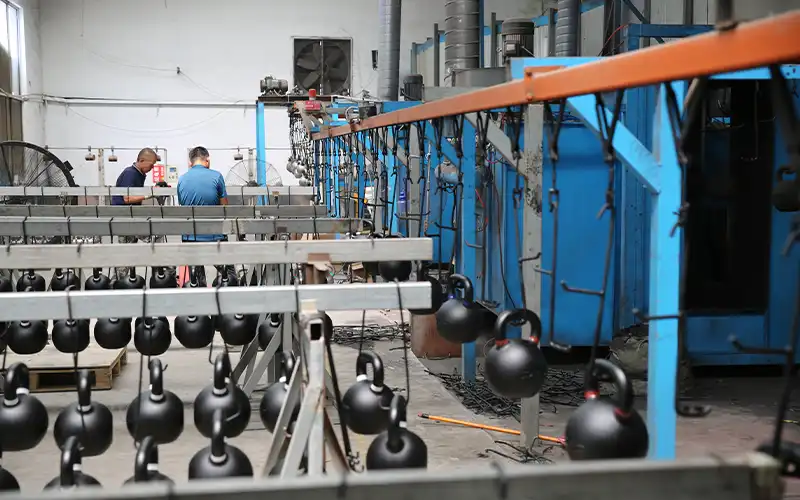
Your kettlebells carry your brand name — not ours. We give you full control over how they look and how they arrive.
• Embossed or engraved logo — Your brand name cast directly into the iron during molding or laser-engraved after finishing. Permanent. Cannot be removed.
• Weight marking — Clear kg or lb indicators, either cast-in, engraved, or silk-screen printed depending on your preference.
• Color options — Full range of RAL or Pantone colors for powder coating. Color-coded weight ranges for easy gym identification.
• Custom packaging: Bulk pallets for container shipping, FBA-ready cartons, retail-ready printed boxes, or fully custom-branded packaging with your artwork.
• MOQ flexibility — Custom mold fees apply for unique shapes or logos cast into the iron. For standard shapes with custom finish and packaging, lower minimums available.
Our in-house mold team handles everything from your design file to first sample — all within one facility, no sub-contracting.
7 QC Checks Before Your Kettlebells Leave Our Factory
Kettlebells that fail any of these checks do not leave our facility. No exceptions.
1. Weight tolerance — Every kettlebell weighed on calibrated scales. Standard: ±2%. Competition-grade: ±1% or tighter.
2. Casting integrity — Visual and tap-test inspection for hidden cracks, voids, or porosity in the iron casting. A clear ringing sound indicates solid metal.
3. Base flatness — The base must sit flat with zero wobble on a level surface. An unstable base is a safety hazard during floor-based exercises.
4. Handle surface — Every handle checked by hand for smoothness. Any rough spots, sharp edges, or casting flash are re-ground.
5. Finish adhesion — Cross-hatch adhesion test on powder-coated samples. Paint must not peel or flake under tape pull.
6. 1.5-meter drop test — Sample kettlebells dropped onto concrete from 1.5 meters. Must show no cracking, no finish chipping, no structural damage.
7. Rust resistance — Salt spray testing (ASTM B117) on finishing samples to verify corrosion resistance for maritime shipping and humid storage environments.
Packed, Palletized, and Ready for Global Shipping
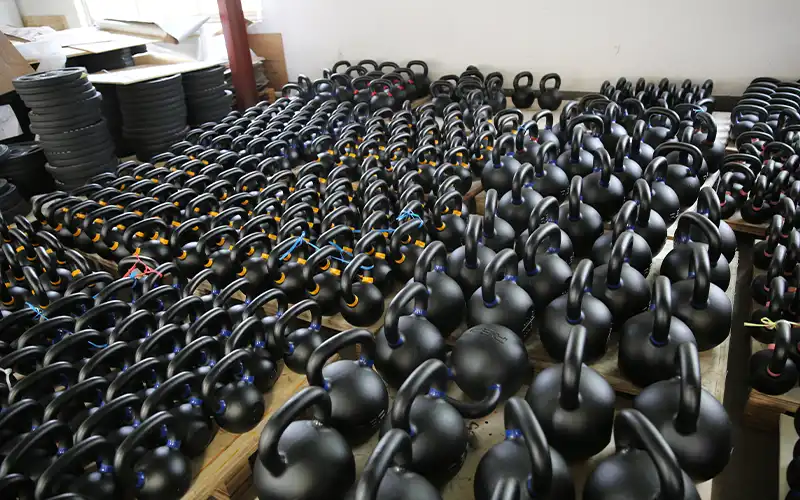
Kettlebells are heavy, dense cargo. How they are packed determines whether they arrive in sellable condition — or damaged.
• Individual protection — Each kettlebell wrapped in foam sheet or bubble wrap, then placed in an individual carton or grouped by weight.
• Pallet configuration — Optimized weight distribution per pallet to prevent shifting during container transit. Standard: 800–1000 kg per pallet.
• Container loading — We calculate exact container capacity by kettlebell weight class to maximize your shipping efficiency. A 20ft container typically holds 22–26 tons of kettlebells.
• Export documentation — Full commercial invoice, packing list, certificate of origin, and any required certification documents prepared by our logistics team.
• FBA-ready option — For Amazon sellers: individual barcoded boxes, FBA-compliant labeling, and pallet configuration that meets Amazon's receiving requirements.
Start Your Kettlebell Order
Quality kettlebells do not happen by accident. They come from proper casting, patient handle finishing, documented QC, and 20 years of knowing what can go wrong.
Contact us at info@landersports.com or visit our Contact page. Tell us your target weight range, preferred finish type, estimated order volume, and any branding or packaging requirements. We will respond within 48 hours with a tailored proposal including specs, pricing, and production timeline.
Need other fitness equipment? Explore our dumbbells, barbell plates, barbell bars, weight training accessories, and gym storage solutions on the Products page.
Frequently Asked Questions
- 1. How are cast iron kettlebells manufactured?
- We use one-piece sand casting. Molten gray iron is poured into a precision sand mold — the handle, ball, and flat base solidify as one continuous piece. No welds. No weak points. After casting, each kettlebell is shot-blasted clean before finishing.
- 2. What surface finishes are available for kettlebells?
- Three options: Electrostatic powder coating (most durable, chip-resistant, for commercial gyms), rubber coating (floor-friendly, quiet, for hotels/apartments), and epoxy paint (lowest cost, for budget retail/home use).
- 3. What is the MOQ for custom kettlebell orders?
- Standard kettlebell shapes with custom color, finish, and packaging start at 100 units. Fully custom shapes with your own mold require tooling investment — contact us for details.
- 4. Do you provide free samples for kettlebell OEM buyers?
- Yes, we ship pre-production samples for quality verification. Sample costs are credited against your first production order. Standard samples ship within 7–10 days.